Capitán Jose Cruz here. The bio bay is the tour people ask me the most questions about before they go: which night, what to wear, can I swim, will my phone get the photo. These are the tips that decide whether you come back amazed or disappointed, pulled from the reserve rules, Puerto Rico’s official tourism guidance and what the tour operators themselves publish.
The short version: go as close to the new moon as you can, take the earliest tour if the moon is big, leave the spray repellent at the hotel, and call the operator the same day.
Best nights to go: new moon dates through mid 2027
Times are for Puerto Rico. The darkest nights are roughly three days on either side of each new moon. The nights around the full moon are the brightest sky and the weakest glow.
| New moon | Darkest nights | Full moon that month (brightest sky) |
|---|---|---|
| December 8, 2026 | December 5 to 11 | December 23 |
| January 7, 2027 | January 4 to 10 | January 22 |
| February 6, 2027 | February 3 to 9 | February 20 |
| March 8, 2027 | March 5 to 11 | March 22 |
| April 6, 2027 | April 3 to 9 | April 20 |
| May 6, 2027 | May 3 to 9 | May 20 |
| June 4, 2027 | June 1 to 7 | June 18 |
The next new moon after these is July 3, 2027. Weather, rain and the bay itself still change from night to night, so treat this as a planning tool and confirm with your operator.
Book a bio bay tour
Tours on all three bays. Check the live calendar for your night and book direct with the operator.
Staying in San Juan? Add a 90 minute San Juan Boat Tour with Oceania Boat Tours, from $100 per person.
Prices are starting points from each operator’s booking calendar. Confirm the price for your date before you pay. Need help choosing? Contact us.
17 bio bay tips that actually change your night
1. Book by the moon, not by the day of the week
The glow is in the water all year. What changes is how dark the sky is. The best nights are the few days on either side of the new moon, and the worst are the nights around the full moon. Check the table below before you buy flights if the bio bay is high on your list.
2. Moonrise matters as much as the moon phase
A bright moon only hurts when it is actually up. In the days after a full moon, the moon rises later each night, so the first tour of the evening can still be dark. In the days before a full moon it is the other way around: the moon is already high at sunset. If your dates are not near a new moon, pick a night after the full moon and take the earliest departure.
3. A cloudy night is not a bad night
On a moonlit night, cloud cover works in your favor because it blocks the moon. Do not cancel just because the forecast shows clouds.
4. Heavy rain is the real problem
A big downpour pushes fresh water into the bay and lowers the salinity, and the glow can drop until it recovers. If it has been pouring all day, call the operator and ask how the water looked the night before. December through April is the drier stretch of the year.
5. Skip the spray repellent and the DEET
Whatever is on your skin ends up in the water, and those chemicals hurt the organisms that make the light. Puerto Rico’s tourism office says to use creams or balms instead of sprays. Put it on well before you get to the dock, not at the water’s edge. Long sleeves and long pants are the better mosquito plan anyway. Some operators hand out their own bay-safe repellent, so ask.
6. Know where you can and cannot get in the water
Swimming is prohibited in Laguna Grande (Fajardo) and in Mosquito Bay (Vieques). La Parguera in Lajas is the only bay where swimming has been allowed, but it is not guaranteed every night, and at least one La Parguera operator states that swimming is not allowed on its tour. If getting in the water is the reason you are going, confirm it in writing before you pay.
7. Do not expect the neon photos
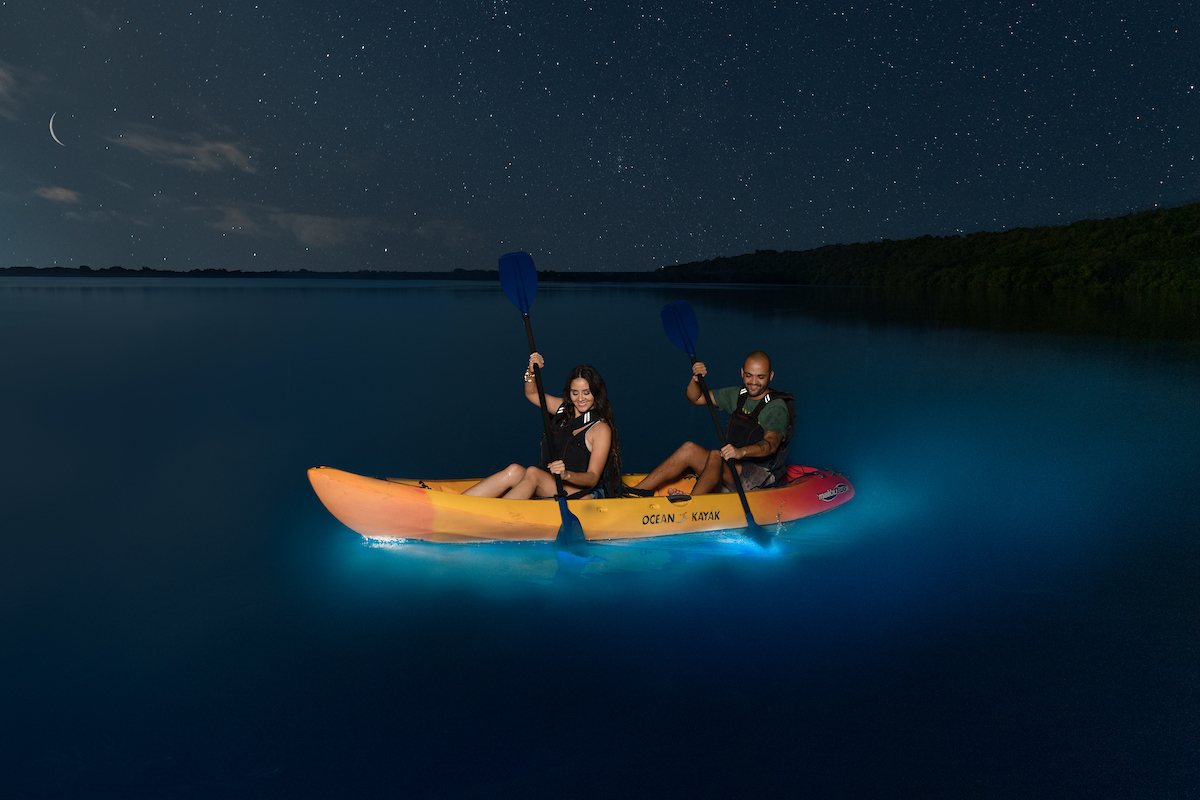
The bay is not lit up wall to wall. The water flashes where something moves it: your paddle, your hand, a fish darting away. The bright blue pictures in ads are long camera exposures. Go in knowing that and you will enjoy it a lot more.
8. Your phone will not capture it
Each flash lasts a split second, so a normal phone shot comes out black. The photos that work are long exposures on a tripod, which you cannot do from a moving kayak. Keep the phone in a waterproof case on a lanyard and use your eyes.
9. Give your eyes ten minutes and kill every light
No flash, no flashlight, no screen at full brightness. The darker your eyes are adjusted, the more you see. Some guides pull a tarp over the kayaks on brighter nights to block the sky, and it works.
10. Dress to get wet
Sit-on-top kayaks let water in through the seat, and at most launches you wade in to about mid-calf. Wear a swimsuit or quick-dry shorts and water shoes that stay on your feet. Leave a towel and dry clothes in the car.
11. Check the fine print before you book
Fajardo kayak tours commonly set a minimum age of 6 and a weight limit somewhere between 220 and 250 pounds per person, and some operators weigh guests at check-in. Several do not take pregnant guests. Rules differ from one company to the next, so read the listing.
12. Cannot paddle? You still have options
La Parguera is the only one of the three bays where motorboats are allowed, so you can see it without kayaking. That makes it the easiest choice for small kids, older relatives or anyone who does not want to paddle in the dark. In Fajardo, ask about electric boat tours.
13. Fajardo is busy, so ask about group size
Laguna Grande is the closest bay to San Juan and the most visited. A limited number of licensed outfitters share one mangrove channel, and on popular nights it is kayak after kayak. Ask how many kayaks go out on your departure and book ahead for weekends and holidays.
14. Vieques means a night on the island, unless you go by boat
Mosquito Bay holds the Guinness record for the brightest bioluminescent bay in the world. Tours run after dark, so most people sleep in Vieques. The ferry leaves from Ceiba and takes about 45 minutes, and the flight from Isla Grande in San Juan takes about 25. The other way is a boat trip from Fajardo that brings you back the same night.
15. Sort out your ride home first
Tours end late and you are far from San Juan with weak phone signal near the reserve. Rideshares back from Fajardo at 10 pm are not something to count on. Rent a car, book a tour with hotel pickup, or reserve a private driver. Save your meeting point offline before you leave the hotel. Our taxi vs Uber guide has the details.
16. Arrive 30 minutes early and eat after
Check-in and the safety briefing take time, and late arrivals lose their spot. In Fajardo, the food kiosks and restaurants in Las Croabas are right there for dinner afterward.
17. Call the same day to confirm
It is a living bay and some nights are better than others. Operators know how the water looked the night before, and they reschedule when conditions are bad. A two minute call on the day of your tour is the best tip on this list.
Getting to the Fajardo bio bay: the route and where to park
Every Laguna Grande kayak tour starts in Las Croabas, at the very end of road PR-987 on the northeast tip of the island. It is about 35 miles from San Juan.
The route from San Juan
- Take PR-26 east, past the airport.
- It turns into PR-66, a toll road. Stay on it to the end in Río Grande.
- Continue on PR-3 east toward Fajardo. This is the stretch with traffic lights, through Río Grande and Luquillo, and it is where you lose time.
- In Fajardo, turn left onto PR-194, then left onto PR-987 and follow it to the end, past Seven Seas beach, into Las Croabas.
Open this route in Google Maps
The three spots in Las Croabas
They sit within about 350 meters of each other along the waterfront, which is why people end up at the wrong one in the dark. Check your confirmation for which one is yours.
- Kayak Village. Kiosks for several kayak companies. Directions
- Old fishermen’s area (Villa Pesquera). Where the fishermen used to be. Kayak companies set up here now. Directions
- Parque Pasivo Las Croabas. The waterfront park. The other launch point, with parking. Directions
How long it really takes
Plan 45 to 60 minutes with no traffic and up to 90 minutes on a weekday afternoon or a holiday weekend. Operators ask you to check in 30 minutes before departure, so for a 6:00 pm tour leave San Juan by 4:00 pm. If you arrive early, the waterfront park and the food kiosks are right there.
Tolls
PR-66 is electronic toll only (AutoExpreso). There are no cash booths. If you are in a rental car, ask at the counter how tolls are charged before you drive off, because unpaid tolls come back later as fines.
Where to park
- The waterfront park in Las Croabas (Parque Pasivo de Las Croabas) has its own parking and is one of the places tours leave from.
- Kayak Village, where many operators have their kiosks, has free parking at the roundabout to the left of the entrance, according to operator instructions.
- Do not plan on the Seven Seas beach lot. The municipality charges $5 a day there and lists parking hours that end at 5:00 pm, before the night tours go out.
- Leave nothing visible in the car, and keep your dry clothes and towel in the trunk for when you come back.
Because companies launch from different spots, use the exact meeting point in your confirmation email, not just “Las Croabas” in your GPS. Save it offline before you leave the hotel.
No car?
Some tours sell round-trip transport from San Juan as an add-on, and a few include hotel pickup. Otherwise book a private driver who waits for you, so you are not looking for a ride in Fajardo at 10 pm.
Where to eat afterward
You will be hungry. Puerto Rico’s tourism office lists these restaurants around the Las Croabas park: Café Playero, El Pescador, Nativo, El Bohio, El Racar Seafood, Ocean View, Pescaito and Pikadera. Kitchens close early on weeknights, so ask your guide what is still open.
Uber, taxi, rental car or a driver who waits: 6 ways to get to the bio bay
The tour is in Fajardo and most visitors sleep in San Juan, an hour away. This is the part of the night people plan the least and regret the most. Full disclosure: the private drivers on this list are ours, through Luxplora, so judge the comparison for yourself.
| How | What it costs | Good | Not so good |
|---|---|---|---|
| Rental car | The car you already have, plus tolls and gas | Cheapest for a group. Leave when you want. | Someone drives an hour back in the dark, tired and wet. No drinks at dinner for the driver. Wet seats. |
| Uber or rideshare | About $57 each way from San Juan (October 2026 estimate, check your app) | Easy to get there. No parking. | Getting one back is the problem. Few drivers are in Las Croabas at 10 pm. Five or more people need an XL or two cars. |
| Official white taxi | $82 each way from the airport area to Fajardo (official fare), plus tolls, small surcharges and tip | Fixed fare, no surge pricing. | Taxis do not wait around in Las Croabas. Arrange the return with the driver before he leaves. |
| Public van (público) | Low | It exists. | Runs in the daytime and not on a tourist schedule. There is no ride back after a night tour. Do not plan on it. |
| Tour with pickup | About $35 to $60 more per person, where the operator offers it | Simple for one or two people. One booking. | Fixed schedule, several hotel stops, a long evening. Not every operator offers it, and some need a minimum group. |
| Private driver who waits | From $250 for the vehicle, 5 hours, up to 4 people | Door to door. The driver waits, your dry clothes stay in the vehicle, and you leave when you are ready. Cheaper per person as the group grows. | Costs more than a rideshare for one or two people. |
Bio bay night cost calculator
Tour plus the ride from San Juan and back. Change any number.
Private driver prices are Luxplora’s flat rates for 5 hours ($250 vehicle of our choice, $600 black SUV or minivan, $750 black van), which covers the drive, the tour and the wait. Parking and tolls outside the metro area are charged at cost. The taxi figure is the official fare and leaves out tolls, tip and waiting time. Everything else is an estimate. Confirm before you book.
Bio bay night with your own driver
This is our service, run by Luxplora. The driver picks you up at your hotel in the San Juan area, drives you to Las Croabas, waits while you paddle and brings you back. The price is for the whole vehicle, not per person.
- Most bio bay nights fit in 5 hours. Extra time is billed by the half hour at the hourly rate ($50, $125 or $150).
- Your dry clothes, towels and phone chargers stay in the vehicle with the driver. The black vehicles carry water so you can rinse off before you change.
- Car seats and boosters are free on request.
- Parking and tolls outside the metro area are charged at cost.
- Want the whole day? El Yunque, Luquillo beach and the bio bay with the same driver for 8 hours is $350, $600 or $900 depending on the vehicle.
Fill this in and it opens WhatsApp with your details ready to send. No payment here.
Captain’s tips for the ride
Getting there is never the problem. Getting back is.. Any app will take you to Fajardo at 5 pm. At 10 pm in Las Croabas, soaking wet, with weak signal, you are competing with every other group for the two or three drivers in the area. Whatever you choose, have the return locked in before you get in the kayak.
Do the math per person, not per ride. A private vehicle looks expensive until you divide it. Four people in a vehicle of our choice comes to about $62 each for the whole night. That is more than a rideshare when the rideshare shows up, and what you are paying for is a driver who is standing there when you walk out.
Leave your dry things with the driver. The best part of having a driver who waits is not the ride. It is walking back to a vehicle that already has your towel, your dry clothes and your phone charger in it, instead of a hot car that has been closed for three hours. Our black vehicles carry water so you can rinse off before you change.
If you take a taxi, make a deal for the return. The official fare is one way. Ask the driver what he charges to come back for you or to wait, agree on it before you get out, and take his number.
If you drive, protect the seats. Trash bags and towels on the seats. The mangrove smell stays in a rental car longer than you think, and rental companies charge cleaning fees.
With a pickup tour, ask how many hotels are on the route. You can spend more time in the van than on the water. Ask what time you will actually be back at your hotel.
Add dinner to the plan. With your own driver you can stop to eat in Las Croabas or Luquillo on the way back without watching the clock on a rideshare.
More detail on fares and when each one makes sense: taxi vs Uber in Puerto Rico and our private transfers and drivers.
What almost nobody tells you about the Fajardo bio bay
Laguna Grande is the bay most visitors do, so here are the details the tour pages skip. Some come from me and some from what operators and recent visitors report.
You will come out smelling like the mangrove
This is the one I tell everybody, and people laugh until they get back in the car. A mangrove channel is warm, still water full of rotting leaves, and at certain times of the year sargassum piles up on the coast and adds its own smell as it breaks down. Tour operators warn about it in their own listings. Pack a change of clothes, a plastic bag for the wet ones, wipes and something to freshen up before the drive back to San Juan.
Not every company launches from the same spot
Most listings just say Las Croabas, but some groups go in by the park and others from the old fishermen’s area. Ask which one when you book, so you park in the right place and are not running along the waterfront in the dark looking for your guide.
It is a real paddle, about a mile each way
The channel from the bay to the lagoon runs roughly a mile, and operators describe 20 to 45 minutes of paddling each way depending on the group and the tide. One leg is usually against the current. If nobody in your kayak has paddled before, say so at check-in. Guides tow people every night and it is nothing to be embarrassed about.
The channel is a two-way street in the dark
Groups heading in meet groups coming out in a narrow tunnel of branches. You follow the small light on the kayak in front of you. Keep right, keep your paddle low, and watch for low branches. Ask your operator whether every kayak carries a light.
The kayaks are two-person
Tours here run tandem kayaks. If you are traveling solo you will be paired with another guest or with a guide. Put the stronger paddler in the back, because the back seat steers.
First tour or last tour is a real choice
The earliest departure leaves with some daylight, so you see the mangroves on the way in, iguanas in the branches and bats coming out at sunset, and you paddle back in the dark. It is the better one for first timers and families. The later departures are dark the whole way, which is better for the glow and harder to steer.
You wade to the kayak, and the bottom is soft
Kayaks are loaded in the water, not from a dock, so you walk in to about your calves or knees. The channel itself is shallow with a muddy bottom. Shoes that strap on are worth it. Flip-flops stay in the mud.
Bathrooms and changing space are limited
There are only a few restrooms near the launch and they are shared with the restaurants, so lines form right before departure. Go before you arrive, and bring tissues.
Rain usually does not cancel the tour
Several operators state that they paddle rain or shine and only cancel for lightning or weather alerts. You are getting wet either way. Ask about the refund policy before you book, not on the night.
A good operator warns you when the glow is low
Some companies call the day before to say the bioluminescence is weak and offer to move or cancel your booking. Ask if yours does. It tells you a lot about how they treat people.
The ride can cost more than the tour
Visitors without a car regularly find that a rideshare to Fajardo and back costs more than the kayak ticket, and finding one for the return at 10 pm is its own adventure. Price the transport before you pick the cheapest tour.
There are ways to see it without paddling
Para la Naturaleza, which manages the Cabezas de San Juan reserve, runs a night visit by trolley and boardwalk, and there are electric boat trips into the lagoon. Good to know if someone in your group cannot kayak.
Which bay do these tips point you to?
- Staying in San Juan with one free evening: Laguna Grande in Fajardo.
- You want the brightest water and can sleep on the island: Mosquito Bay in Vieques.
- You do not want to paddle, or you want a chance to swim: La Parguera in Lajas.
For prices and operators side by side, see our bio bay tours comparison. For the longer version of this choice, read which bioluminescent bay you should visit and the La Parguera guide. Planning the whole trip around the calendar? See things to do in Puerto Rico by month.
Frequently asked questions
When is the best time to see the bioluminescent bay in Puerto Rico?
The darkest nights, which are the few days on either side of the new moon. The glow is there all year, but bright moonlight makes it much harder to see. December to April is the drier season, with fewer rainy nights.
Can you see the bio bay during a full moon?
You can still go, and the organisms still flash, but the glow looks much weaker under a bright moon. If your dates fall near the full moon, pick a night a few days after it and book the earliest tour, before the moon comes up, or ask the operator how they handle bright nights.
Can you swim in the bioluminescent bay?
Not in Laguna Grande in Fajardo or Mosquito Bay in Vieques, where swimming is prohibited to protect the bay. La Parguera in Lajas is the only one where swimming has been allowed, and it is not offered every night or by every operator, so confirm before you book.
Can I wear bug spray on a bio bay tour?
Avoid aerosol sprays and DEET right before the tour, because chemicals that wash off your skin harm the organisms that make the glow. Puerto Rico’s tourism office recommends creams or balms instead of sprays. Long sleeves and long pants do most of the work.
Can I take photos of the bioluminescence with my phone?
Usually not. Each flash lasts a fraction of a second, so the photos you see online are long exposures taken on a tripod. Bring the phone in a waterproof case if you want, but plan to watch with your eyes.
Does rain ruin the bio bay?
Heavy rain can. A lot of fresh water lowers the salinity of the bay and the glow can drop for a while afterward. Light cloud cover actually helps on moonlit nights because it blocks the moon.
Not sure which night or which bay fits your trip? Ask us and we will point you to the right tour.
Sources: Discover Puerto Rico, bio bays and its guide to protecting the bays; Guinness World Records; tour operator listings for Laguna Grande, Mosquito Bay and La Parguera. Moon dates are astronomical calculations for Puerto Rico time.